If you have been
following my posts, you know that I conduct book giveaways here and on my own
blog Coffee With David (http://davidalanlucas.blogspot.com/). Surprisingly,
even though people comment, they don't always claim their prize. Because of
this, I am reposting one of the books I posted on Coffee with David to win
here. The following giveaway article and
interview was posted on Coffee with David.
Please join me
(again) for a great book to give away followed by one of my favorite
"Coffee With David" interviews.
_______________________________________________________________________
Our
world has changed and information is passed among people like a runaway fire.
We have seen it. Newspapers struggle to adjust and the "television
networks" have found that they must be a part of the social media world or
fall into extinction. The social media is not just for the news, people keep up
to date on events, friends, family and almost anyone they want. Writers,
actors, artist, and others have turned to the social media to attract people to
their work.
This
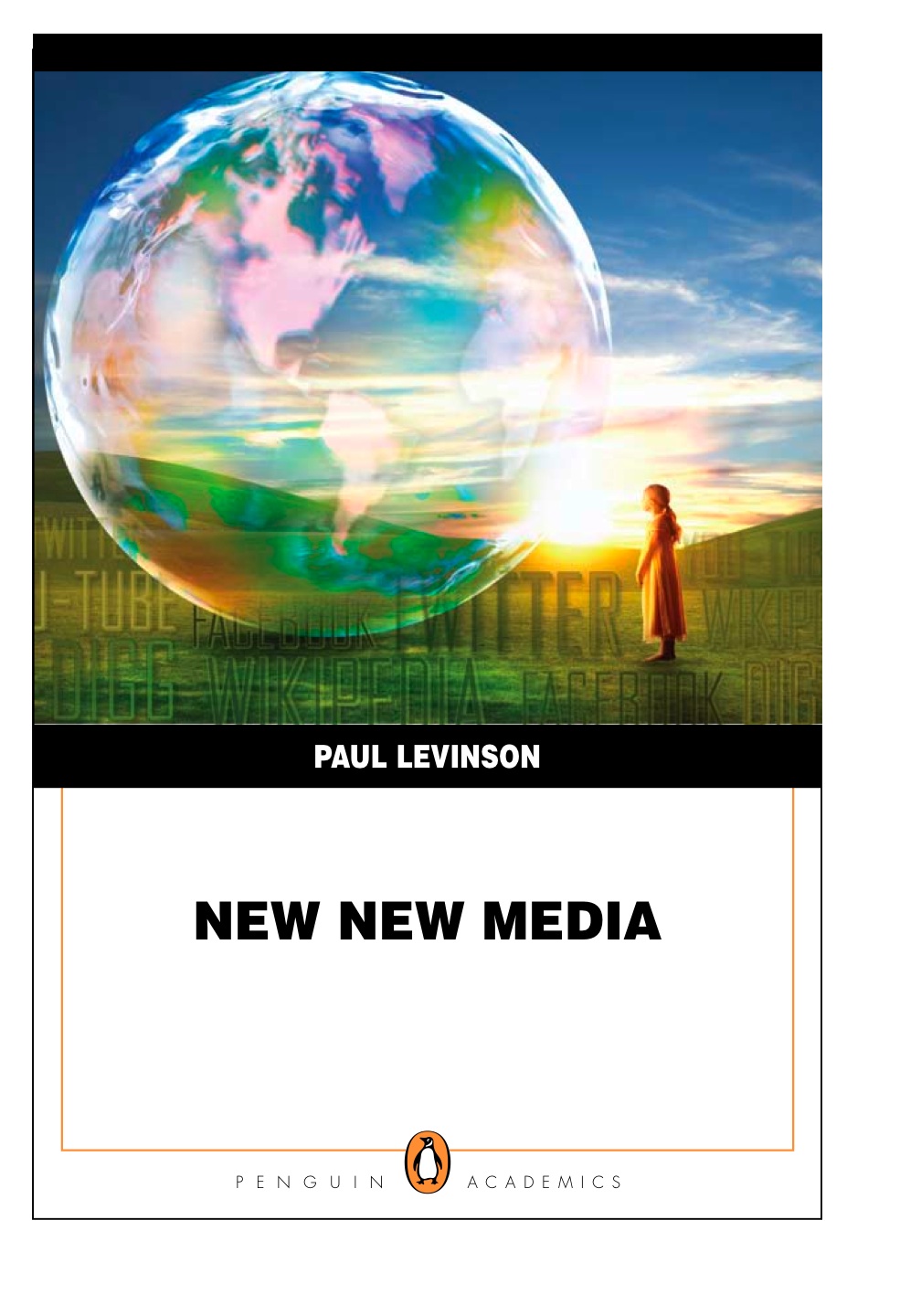
week, the Writers' Lens is giving away New New Media. In New New
Meida, author and Professor of Communication & Media Studies at Fordham
University Paul Levinson will take you on a tour of : YouTube, blogging,
Wikipedia, Twitter, Facebook, Second Life and other “new new media” are
transforming just about every aspect of our culture from the way we elect
Presidents to how we watch television. New New Media details the
benefits, opportunities, and dangers of these transformations.
It is also my honor and pleasure to
present an interview with the man who always has his eye on the future and on
the media--Paul Levinson. Paul is an author of science fiction author and
non-fiction, professor of communications and media studies at Fordham
University, former President of the Science Fiction and Fantasy Writers of
America, songwriter, recording artist, and frequent guest on local, national
and international cable and network television and public, commercial, and
satellite radio programs.
Interestingly enough, I first
"met" Paul on Facebook and struck up a conversation on writing. I
have a massive level of respect for him and when he speaks about writing, the
media, and social media I close my mouth and open my ears widely.
And now . . .the (reposted) Coffee
with David interview with Paul Levinson:
David Alan Lucas: Your book, New New
Media, covers the promise and the danger of various social media (from Facebook
to Twitter and beyond). As a professor of Communications and Media, Science
Fiction author and commentator on media and its effects, where do you see the
(r)evolution of social media going in the next several year? Do you think this
will be a phase of this day or do you think it will continue to change and grow
100 or more years from now?
Paul Levinson: Predicting the future
is always a hazardous undertaking. But the human drive to create, to get
into the mix, is so great, and so effectively expressed in the new new media
which give all consumers of information the opportunity to be producers, that
I’m 100% certain that Facebook, Twitter, YouTube, and whatever they may be
called in the future will be as much a part of human life as reading, writing,
hearing, speaking, and thinking.
DAL: How much research and what
kinds of research did you do for this book?
PL: I’ve spent many enjoyable hours
a day online at least as far back as 1984. I combined what I learned in
that way with what I learned reading media theory (Marshall McLuhan),
philosophy (Karl Popper), and more for forty years. And I mostly
used to the Web to get specific references (articles in newspapers, etc)
about news events when needed.
DAL: 2011 was a year in which social
media was instrumental in forming the face of our current world and has helped
various nations in Africa and the Middle East over throw governments and form
new ones. They have only taken the first brave steps into a new world,
but how do you see social media as a tool in continuing their quest for change?
PL: Marshall McLuhan’s global
village, just a metaphor when he wrote about it in the 1960s (communities of
television viewers were national not international, and could only watch not
communicate), has become reality with Twitter, Facebook, and YouTube available
to everyone. The Arab Spring and Occupy Wall Street are just the
beginning of a resurgence of direct democracy that the social media have
engendered. Representative democracy and totalitarian governments in
their own ways are predicated on mass media, and the arm’s length to
information that mass media dictate. In contrast, social media put
the power to comment and report upon information in everyone’s hands.
DAL: How do you see social media
effecting "traditional media" and how do you think that
"traditional media" will evolve and adapt to the consumer as a
result?
PL: Just as in the biological world,
media both compete and cooperate with one another for survival. Some
traditional media, such as paper newspapers and books, are clearly suffering
from the competition of digital media. Others, especially television,
have figured out how to utilize social media - for example, use blog and
tweets to promote their programs. In addition, radio and television are
increasingly using the web and digital devices as platforms for their
content. As long as a medium does something valued by human beings,
and does this better than any other medium, it is likely to survive. I
call this the “media ecological niche”.
DAL: You have used social media in
some interesting methods to give author interviews. One of my favorite
examples is your use of the VR world of SecondLife to give VR live
interviews. What did you need to do, besides register to be a SecondLife
resident, to hold interviews like this?
PL: You need a good acoustic set-up
- a professional microphone is better than the one that your computer may
have. In Second Life itself, you can purchase clothes and accessories
with “Linden” dollars to give your avatar a desired appearance. For
example, I purchased a monacle (for the equivalent of a few cents), which you
can see on my face in a few interviews. And, of course, you have to
be invited by someone - another avatar, with a real person behind it - to do
the interview.
DAL: Between 1998 and 2001, you were
the President of the Science Fiction and Fantasy Writers of America. What
do you see as the role of Science Fiction and Fantasy in today's literature?
PL: Science fiction was and
continues to be the only form of literature that captures what most makes us
human in this universe: our capacity to dream, plan, envision changes in
the universe, and implement them via our technologies. Space travel
would be the prime example of our success in this venture. Time
travel would be a prime example in which no implementation has worked, as far
as we know.
DAL: When you are starting to work
on a new non-ficton book, what do you find brings the story into focus for you?
Is it different for a new novel?
PL: In both cases - nonfiction and
fiction - it is the writing itself which brings the book into
focus. I don’t write from outlines. I have a general idea of
where I want the book to go, and, in the case of novel, I often have little
idea about what the ending will be until I’m well into the novel.
DAL: What key things make your
novels work?
PL: Pinpoint accuracy about what is
real, true, and factual in the novel, and making the difference between the
fact and the fiction as thin and transparent as possible, is the mainspring of
my fiction. I always like it when a reader seriously asks - is that
really true, do the Amish have lamps that work with fireflies, did the ancients
record sound on pottery? And then, as far as characters go, writing
them from your own experience, investing as much as possible of you in
them. When my daughter - then 12 - exclaimed after reading The Silk Code
in manuscript, “Daddy, Phil D’Amato is just like you!” - I knew I had succeeded
with this character.
DAL: What was the hardest part of a
non-fiction book? Is it harder or easier than writing a fiction novel?
PL: Writing fiction and nonfiction
is apples and oranges. I guess the hardest part of writing fiction is
when you get to a place and don’t where to go in the story - fortunately, the
solution usually comes to me pretty quickly, from walking around the block,
watching television, or taking a trip to England. In nonfiction, the
toughest part is tracking down a reference which I know I saw but I can’t now
lay my hands on. But this is not deeply difficult - it’s more like
a paper cut.
DAL: What themes in your fiction
writing seem to drive you the most?
PL: In no particular order of importance
(because they are all important to me): the paradoxes of time travel; the
possibility that prehistoric people had sophisticated knowledge of which we
know little or nothing; the symbiosis of biology (how living organisms
unintentionally help each other live - like bacteria which help us digest our
food); back to time travel, how traveling to the past to prevent an event
serves to make that event happen; the possibility that the person next door or
in the pizza place may be an alien or a time traveler.
DAL: Do you work on multiple novels
or books at once? If so, how many?
PL: In one sense, I have at least 5
novels and 5 nonfiction books on some kind of burner - more than in my head, at
very least part of an opening chapter and usually more - at the same
time. But this same time can be and indeed is a long time - years - and
once I start really writing a novel or nonfiction book, I put the others
aside. Only exception: I had the idea, when writing my doctoral
dissertation in the late 1970s, that I would write that and my first science
fiction novel at the same time. Didn’t last too long - I soon discovered
that I was enjoying writing the novel so much, that’s all I was writing.
So I put it aside, so I’d have a chance of finishing the dissertation, which I
did.
DAL: How easy was it to take the
leap of faith to become a serious writer and chase this career?
PL: I’m the type of person who
thinks that anything I really enjoy as a fan, in popular culture, is also
something I can do. As a kid, I loved rock ‘n’ roll and science
fiction. Before too long I was writing both, went on to release an
album, “Twice Upon a Rhyme,” and get my science fiction published.
In both cases, for me, the leap of faith to writing took place when I first
fell in love with the genre.
DAL: In years past, new writers
would battle their way in the pulp magazines to build their readerships and
their careers. Do you think that is still the case in the explosion of
electronic readers, blogs, e-zines, and other like media? Who do you see as the
current gatekeeper of the good writers and those who are still developing?
PL: Gatekeeping rusts and crumbles
with every digital advance. The new non-gatekeepers are the people,
the readers themselves. When something is published online - as a
blog, a tweet, or a YouTube video - it has already breezed through what the
traditional gate kept out. The content of new new media live or not
based on their reception by the ultimate audience - the world at large.
DAL: When you plot your novels, from
whose point of view do you plot from? The protagonist’s? The antagonist’s? The
narrator’s? Someone else?
PL: Always primarily from the
protagonist - who, as I indicated above, is always some form of me.
But I’m in the antagonist’s mind, too - and, for that matter, the
narrator’s. Every conceivable thought or perspective I could have on a
subject, or in a situation, is a potential resource for a point of view in my
stories. If I’m writing a villain, you’re reading what I can imagine doing
were I not the civilized being that I hope I am.
DAL: Arthur C. Clarke once wrote
that when science catches up with the science fiction writer, the science
fiction writer needs to make a leap forward. How do you stay ahead of the
game?
PL: When it comes to time travel,
there is no need to move forward, because not only has science not caught up,
it has not even moved one inch or second forward. (That’s because I think
as a matter of fact that time travel is impossible.) Regarding
other elements of science fiction, all that leaping forward requires is
consultation with your unbridled imagination. When I experience
anything, I can’t be help but move it to the next step in my mind.
DAL: What is your writing schedule
like?
PL: Writing whenever I please, and
not letting any of the myriad of good reasons not to write - professional and
social responsibilities, and enjoyment of non-writing activities - not letting
these other worthy and wonderful things get in the way of my
writing. If you lead a zesty life, with lots of opportunities for
meaningful work and fun other than writing, finding time for writing can be
tough. But you’ve got to give your muse close to absolute authority to
preempt anything else you might want to do.
DAL: If you could have coffee (or
drink of your choice) with four other authors from any time period, who would
you choose and why?
PL: Marshall McLuhan, whom I had
many lunches and dinners with in the last years of his life (he died in 1980),
was the smartest person I’ve ever known. I’d love to have another cup of
tea with him.
I met Isaac Asimov once, but spoke
to him on the phone and corresponded with him over the years. In my
view, he is the greatest science fiction writer of all time (Foundation
trilogy, robot stories, time travel). I’d love to have a cup of tea with
him.
John Stuart Mill’s philosophy on
freedom, especially freedom of expression, has been a great inspiration to
mine. A cup of tea with him would be just the thing.
Of all the ancient philosophers,
I’d probably choose Aristotle, over even Socrates and Plato, because
Aristotle understood and could talk about their philosophies, as well as his
own work in science and politics. I might go for a little ancient Falernian
wine as the libation.
DAL: You, with Tina Vozicik, had
founded and operated Connected Education from 1985 to 1997, which offered
online Masters Classes and degrees in Media Studies and Creative Writing. You
are currently a professor at Fordham University. In both roles, where do
you see the future of higher education possibly going? Will the days of lecture
halls fade away some day for halls in an internet or virtual reality or will
there be a balance?

PL: Lecture halls are already being
replaced by online (text) and video classes. But there is an irreducible
appeal of in-person presence - we are, after all, flesh and blood beings -
which means that the in-person lecture hall will be totally or even mostly
replaced. Certainly in-person classrooms will do better than
hieroglyphics did in competition with the alphabet, and even better than
theater did in competition with movies and television. In fact, I’d say
in-person teaching will fare better than movies have done in the age of
television. Higher education will flourish both online and
in-person.
DAL: How could my readers learn more
about you?
PL: The single best place, I’d say,
is my blog, accessible in all kinds of ways but most easily via
http://PaulLevinson.net - it consists mostly of my TV reviews and
political commentary, but also has links to my music, books, and all kinds of
other things. Following my Twitter account - I’m PaulLev - is probably
also a good idea, and I follow most my followers back.
How
do you win a free signed copy of this book? To enter the contest,
simply leave a comment or question on the Coffee with David blog between now
(July 2nd) and midnight July 7th, 2012. Please include your email so I can
reach you if you win. The more comments you leave, the greater your chance of winning
the contest. If you refer others to The Writers' Lens who mention your name
in their comments, I'll enter your name again in our random number generator
along with theirs, also increasing your chances at winning! The winner will
be chosen after midnight on Monday April 30, and the announcement made on
Sunday, July 8th, when I will post the next contest. Good luck and comment
often.
Thank
you for reading and please visit www.davidalanlucas.com and www.thewriterslens.com. You can also follow me
on twitter @Owlkenpowriter and the Writer’s Lens @TheWritersLens. Fiction is
the world where the philosopher is the most free in our society to explore the
human condition as he chooses.